More hands, same head
The follow-up to "Yes, I use artificial intelligence": what happens when the mechanical work gets out of the way.
A few days ago I wrote that I use artificial intelligence and how I use it, and I thought I was done with the subject. Then I reread the piece and realized the most important part was missing: not what I have it do, but what it is giving back to me, because ever since the mechanical work stopped passing through my hands I can finally focus on what really matters.
I am still teaching it to write like me
In the last article I said I have it comment the code and write the documentation, and I am still working on that: sometimes it comes out stilted, or it drags along concepts that belong more to the conversation between me and the agent than to the page. I am not working on it to hide anything, I am writing it here and I have been saying it on Twitter for months: I work on it because I review every single line of code, every article, every comment block and every documentation page it generates, and the more it settles into my tone the fewer corrections I have to suggest. Which does not mean "so it generates and I stop looking", it means I read, it flows, I have nothing to send back, I gain time. In the end the point is always the same: time, without making quality pay the bill, and for me, as a UX designer, quality is EVERYTHING.
It took me years to figure out what my job is
I have been working in this world for more than fifteen years and I struggled a lot to understand what the hell my role was: I program but I do not feel like a programmer, I build interfaces but I do not feel like a designer. Yet I listen to problems and I feel at home, whether it is a design problem, a code problem or an architecture problem, that is my place: I work on the experience, the user's or the developer's, what I care about is their experience with that product, and mine too. I am a... UX/DX designer, I guess? The title does not exist, but it is the most honest one I have found.
More hands than before
I love watching my architectures come to life, I love looking at the code and saying "no, this is not good, the whole block gets redone", or "this is a mess, too many downsides, this thing needs to change drastically". And today I can actually do it, because I have more hands than before: something that used to take me months or even years to build is now within my reach, and above all I can poke at that code ten, a hundred, a thousand times if necessary, because behind it I am not irritating anyone who wrote it, there is only a generator. No colleague to wear down with the umpteenth "let's redo it", no relationship to burn through: just me, the idea, and the freedom to be as demanding as I want.
The issues, the commits, and Pietro
Then there is the story of the commits. I have been criticized MANY times, over the years, for not documenting my commits, and they are right: it does not come naturally to me, I often do not follow standards, and switching to feat, fix, chore and docs cost me quite a bit, even though today I appreciate it. Pietro, my lifelong colleague and partner at fabricators (lowercase, yes), pokes me about it every single day, rightfully. But it is not my thing: I have a head that spits out ideas every single day, I literally have a little notebook where I write them down, a gift from my bride, who watches me stop in the middle of the street with light bulbs going off all the time, thank you Laura, I still use sheets of paper to draw the diagrams of these ideas, and it is cool but exasperating, and between documenting a commit and working on the holes of an architecture or on the style of the code, I will always pick the latter.
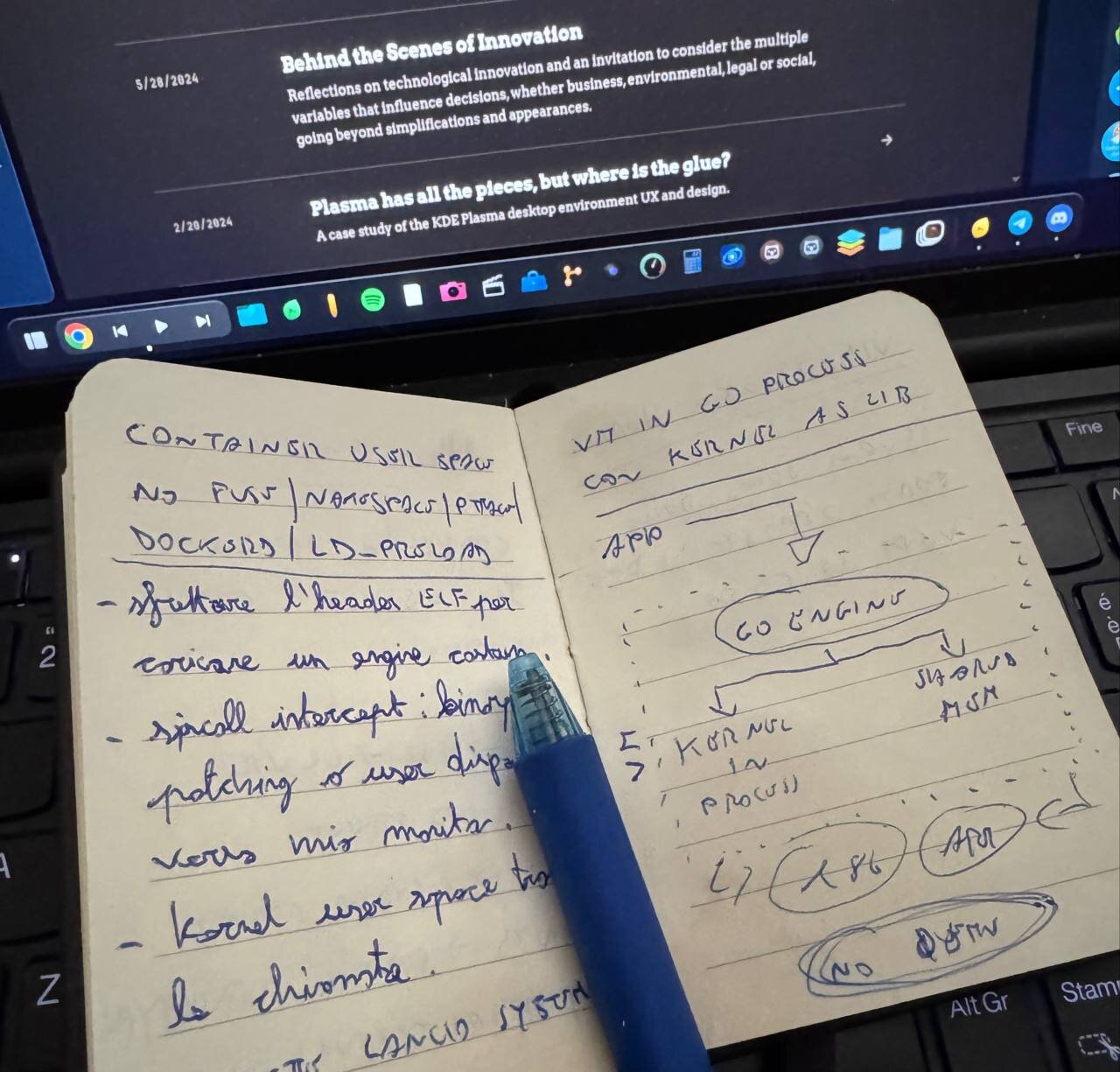
Here it is, the little notebook. And yes, the handwriting is terrible: my apologies, but I understand myself just fine.
Recently I fixed this one too: the agent creates the issues for me, focused, rich, explained, and I close them myself in the commits. The ideas leave the notebook and become issues anyone can read, and every commit finally tells its story without me having to betray my nature to write it.
What really matters
If I line all these things up, the picture is a single one: every hour I do not spend commenting, formatting, documenting, is an hour that goes back where I always wanted to be, on the experience. On the architecture that holds, on the interface detail nobody will notice but everyone will feel, on the idea in the notebook that this time does not stay a drawing. For fifteen years I also did the job I was not, so I could occasionally do the one I am: now the proportions have flipped, and I have no intention of going back.